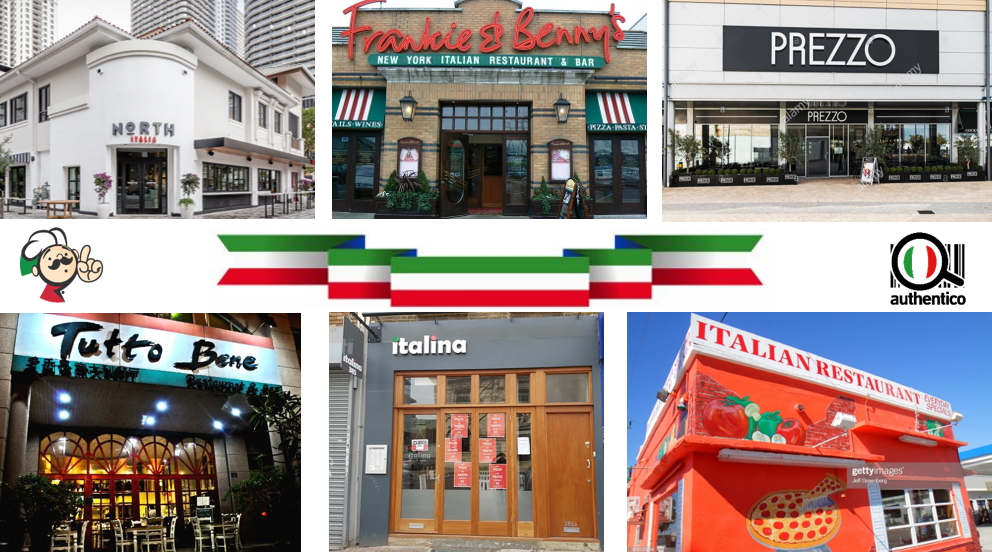
How many people, every day, get attracted by a fake Italian restaurant because the signage claims the food served is “authentic Italian”. Unfortunately, too many times the dishes on the menu are just poor imitations and pure crimes against the Italian cuisine!
We have collected our 10 best advises to recognize a fake Italian restaurant, explaining which ones are the things an Italian would notice and would get suspicious about.
- Spelling mistakes on the menu
This is the sign No. 1. If a menu shows spelling mistakes, that probably means that not even one single person in the restaurant is Italian. Better go somewhere else!
A classic example is pasta (or pizza) funghi: this is grammatically incorrect. It should be pasta (or pizza) “ai funghi” or “con i funghi”. Why would you translate a word in Italian but use an incorrect grammar? That’s suspicious! Or fungi. It’s funghi (mushrooms); linguine not linguini, salame not salami.
- No one is Italian
This is rather worrying. If the chef isn’t Italian, than at least the owner, or the manager should be.
The presence of an Italian waiter could also help.
- Dishes that aren’t Italian
In Italy, the Alfredo Sauce doesn’t exist and hardly anyone has ever heard about it.
Spaghetti with Meatballs, Chicken Parmigiana, Pizza Pepperoni are not Italian recipes either.
So, if on the menu you see garlic bread, bread and oil, pasta with chicken, or any other fake dish, move on and look for another restaurant.
- “Italian” everywhere
If an ingredient calls itself “Italian” or “Italian-style” you can be sure that it is actually fake. Take for example the “Italian” salad dressing. There is no Italian salad dressing that actually exists – we only use oil, salt and vinegar to dress our salads.
Same goes if a dish calls itself “Italian” or “Italian-style”. Here is one reason that will convince you on its own: traditional Italian dishes are regional, not national.
- Number of ingredients
Italian traditional food is very simple. The flavors are always distinct. It is about bringing out the best from every product. Usually no more than four or five ingredients are needed, plus salt and pepper.
So, if you see a dish that contains more ingredients than that, you can be sure that’s not authentic Italian.
- Over-use of “fashionable” ingredients
Have you noticed how pesto is everywhere? Pasta, salads, panini.
In Italy it is only used with pasta!
And balsamic vinegar is not used everywhere. Nor are sun dried tomatoes.
- Chicken everywhere
We don’t put chicken on pasta. Actually, we never top pasta with meat, except in rare cases, like ragù alla bolognese (aka bolognese sauce) or Pasta alla Genovese.
No chicken on pizza. No chicken in lasagne!
- Cheese on fish
There are some strict rules in the Italian cuisine. One of these is that no cheese goes on fish.
We have some recipes that use parmesan to whip pasta with clams. But if you see waiters approaching clients having fish to offer some grated cheese, than you know you’re not in a fake Italian restaurant.
- Pasta as a side dish
Another strict rule. Pasta is never a side dish. It is a main and it’s the only way to have it.
- Flag
The general rule is: the bigger the Italian flag outside the restaurant the greater the risk of having entered an Italian fake restaurant.
We thought this could be somehow confusing, since some people would think some of the things we mentioned are 100% Italian.
Around the world there are about 100 thousand restaurants that claim to be Italian. Truly authentic restaurants are only 5%. Luckily there is our free app that helps you discover only the closest real Italian restaurants.
Buon Appetito!
[enjoy]
Claim “artigianale” sul cibo, cosa cambia davvero dal 7 aprile con la legge 34/2026
La nuova legge avrà un forte impatto nel comparto alimentare con effetti molto concreti su [...]
Apr
Data Science & ML Skills: Pipeline, EDA, SHAP, A/B Tests
Data Science & ML Skills: Pipeline, EDA, SHAP, A/B Tests Practical, no-nonsense guide to the [...]
Quando il “Prosciutto” diventa una parola qualunque: l’indagine sul più grande furto alimentare del pianeta
C’è un mercato fantasma che fattura più dell’Italia intera. E adesso ha anche una licenza [...]
Apr
Cloud & DevOps Documentation: Tools, Workflows, and Best Practices
Cloud & DevOps Documentation: Tools, Workflows, and Best Practices Short answer (featured snippet friendly): Combine [...]
Reapop Guide: Build Robust React Redux Notifications
Reapop Guide: Build Robust React Redux Notifications Reapop Guide: Build Robust React Redux Notifications Short [...]
How to Claim, Verify & Customize Your Spark Project Listing
How to Claim, Verify & Customize Your Spark Project Listing How to Claim, Verify & [...]